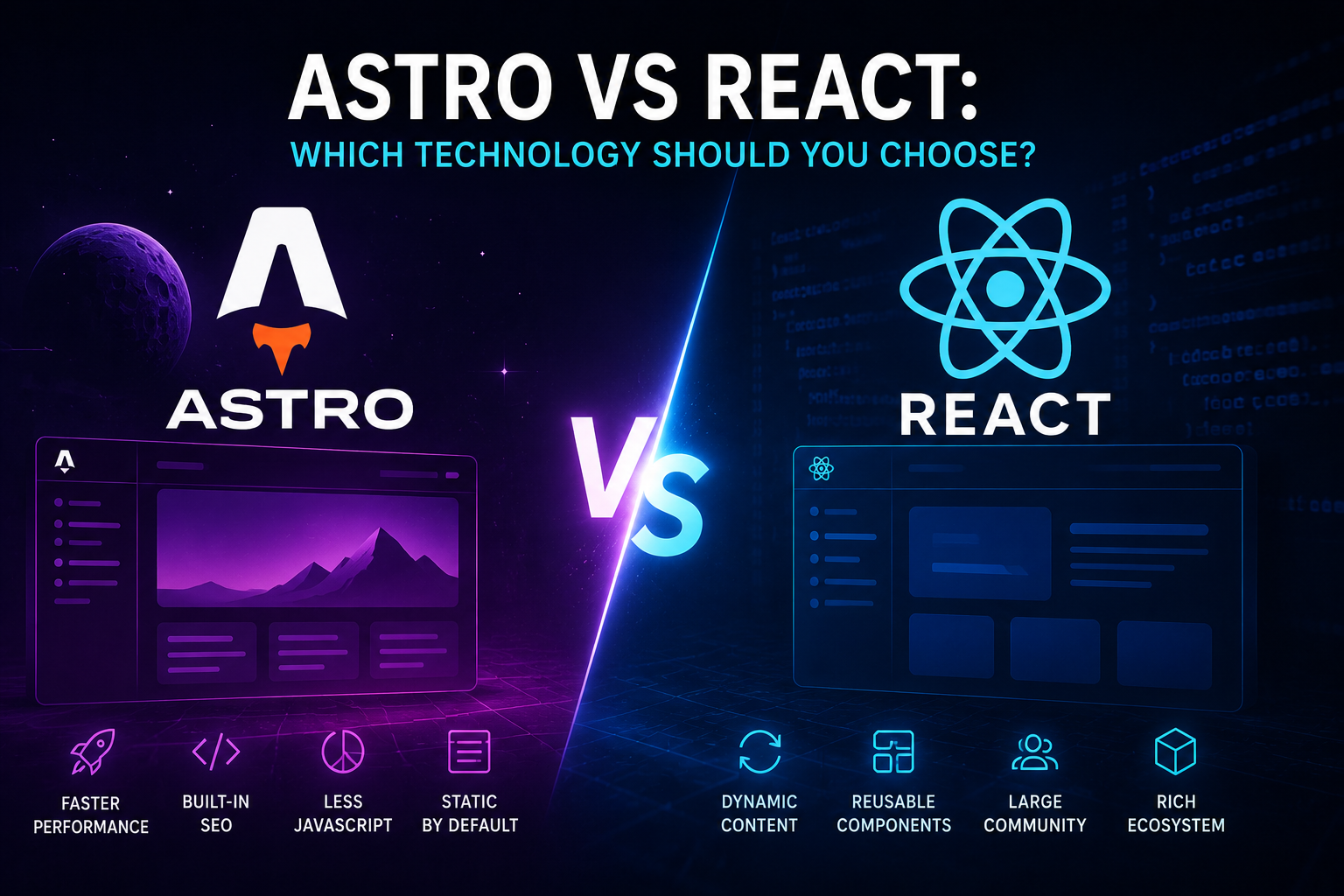
Choosing the right frontend technology can shape website speed, user experience, development effort, and long-term maintenance. The Astro vs React comparison matters because both support component-based development, yet they solve different problems. Astro focuses on content delivery and minimal browser-side JavaScript, while React supports highly interactive interfaces. The better choice depends on what users need to do, how much content the site contains, and how the product may grow.
Understanding Astro and React
What Is Astro?
Astro is a web framework for content-focused websites such as blogs, documentation portals, marketing sites, portfolios, and landing pages. It renders most content as HTML and sends JavaScript only when a component requires interaction.
Its islands architecture lets developers add interactive sections without hydrating the whole page. A search field, pricing calculator, or carousel can use JavaScript while surrounding text and images remain lightweight. Astro also supports components from React, Vue, Svelte, and other frameworks.
What Is React?
React is a JavaScript library for building component-based user interfaces. It is commonly used for dashboards, SaaS products, ecommerce applications, and other experiences that respond frequently to user input or changing data.
React helps developers manage reusable components, application state, forms, events, and dynamic content. For complete applications, teams usually pair it with a framework or supporting tools for routing, server rendering, data loading, and deployment.
Astro vs React: Comparing the Core Architecture
The main difference in Astro vs React is how each technology delivers and activates interface components.
Astro follows a server-first approach. Its components render without sending JavaScript to the browser by default. Developers selectively hydrate only the parts that need interaction through client directives, reducing unnecessary scripts on content-heavy pages.
React is centred on interactive UI development. Components update when state or data changes, making React effective for products where the interface continuously responds to users. Teams must still plan rendering, code splitting, caching, and state management carefully.
Performance and JavaScript Delivery
Performance often drives the Astro vs React decision. Astro can provide a lean starting point because static content does not need client-side JavaScript. This can support faster loading on editorial, marketing, and documentation websites with only a few interactive elements.
React can also perform well, but results depend on the selected framework, rendering method, bundle size, component design, asset optimisation, and caching. A well-built React application can feel fast, while a poorly structured one may deliver more JavaScript than users need.
Astro generally suits content-led projects. React is often better when interaction, live updates, and application logic form the main experience.
SEO and Content Visibility
In an Astro vs React SEO comparison, rendering strategy matters more than the technology name alone.
Astro can generate accessible HTML for articles, service pages, product information, and documentation. Teams must still manage metadata, structured data, headings, internal links, accessibility, image optimisation, and content quality.
React can also support SEO when used with server rendering, static generation, or another suitable strategy. Problems may appear when important content relies entirely on delayed client-side execution. Technical SEO should therefore be planned from the beginning.
Development Experience and Scalability
React has a mature ecosystem and works well for large applications with complex workflows, shared design systems, real-time data, and detailed state management.
Astro offers a focused experience for content-rich websites. It can connect with headless CMS platforms, generate large groups of pages, and use server rendering where dynamic content is required. Teams can also place React components inside Astro, so the Astro vs React choice does not always have to exclude one technology.
Scalability should be judged by project type. A publication with thousands of pages has different needs from a dashboard with continuous updates.
When Astro Is the Better Choice
Astro may be stronger when a project prioritises fast content delivery, technical SEO, low JavaScript usage, and selective interaction. It suits corporate websites, blogs, knowledge bases, product pages, and campaign platforms.
Businesses may use astro js development services for architecture planning, CMS integration, component development, migration, performance optimisation, and maintenance. Experienced teams can also identify which elements need hydration and which should remain static.
When React Is the Better Choice
React may be more appropriate when users manage accounts, edit information, collaborate in real time, or move through complex workflows. It suits SaaS platforms, operational dashboards, advanced ecommerce interfaces, booking systems, and customer portals.
A react js web app development company can support component architecture, state management, API integration, testing, and scalable interface development.
React may also reduce adoption effort when a business already has an experienced team and an established component library.
Can Astro and React Work Together?
A practical Astro vs React strategy can combine both technologies. Astro can manage routing, layouts, content pages, and static delivery, while React powers selected components that require browser events or application state.
This approach works well for informational websites that also include advanced search, filters, calculators, booking tools, or account widgets. It gives teams React’s interactive strengths without applying the same JavaScript model to every page element.
Final Verdict
There is no universal winner in Astro vs React. Astro is often better for content-led, performance-sensitive websites with limited interaction. React is usually stronger for application-led products with complex state and frequent interface updates.
Before choosing between Astro vs React, teams should assess page types, user journeys, rendering needs, CMS requirements, integrations, developer expertise, accessibility, testing, and long-term maintenance. The right technology supports the required experience without adding unnecessary code or operational complexity.