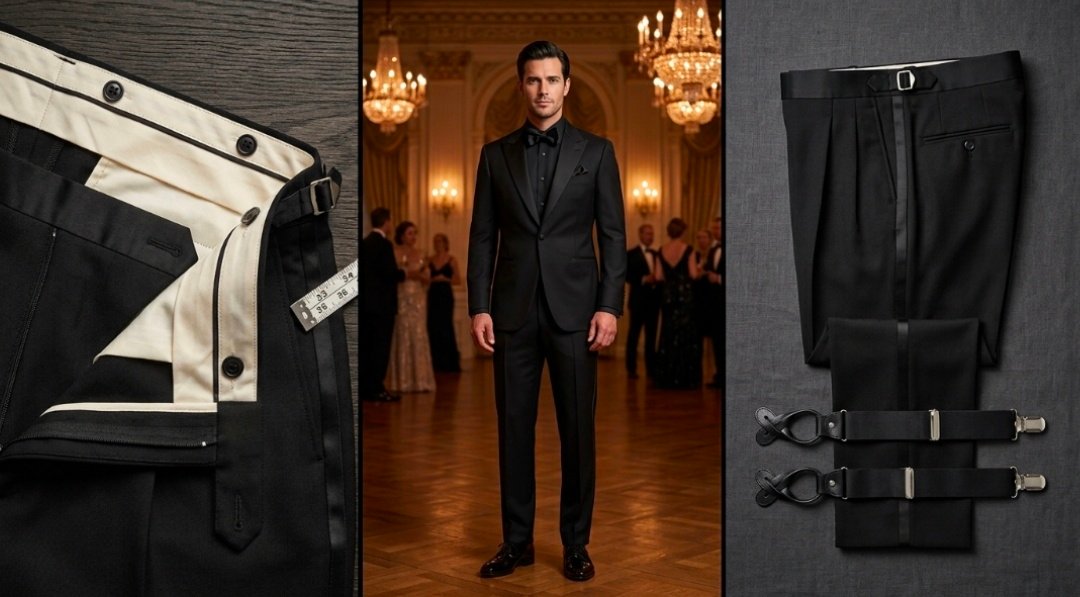
Formal-braces guides spend their pages on the straps — colors, silks, etiquette — and skim the half of the system that actually decides the evening: the trouser. Suspenders with tux trousers are a two-part mechanism, and the pant side carries most of the failure modes: missing buttons, wrong rise, rental-pant surprises, waistbands that were never cut for suspension. Get the trouser side right and any decent set of braces performs; get it wrong and the finest silk braces in the room can’t save the line. This manual works the neglected half: the formal trouser’s suspension anatomy, the button audit and installation spec, the rental-and-borrowed-pants playbook, the rise-and-fit standards suspension demands, and the pant-side checks that finish the dressing sequence.
The Formal Trouser’s Suspension Anatomy
The tuxedo pant is engineered for braces, and reading its anatomy explains every rule. The waistband: cut clean and beltless — a correct formal trouser has no belt loops at all, because the belt was never part of the design; the waistband’s job is to sit at the natural waist and be carried, not to cinch. The rise: higher than casual trousers by design — the length that places the waistband at the natural waist where suspension works and the jacket’s button stance expects it. The buttons: the suspension interface — six waistband buttons (four front, two rear) positioned to load braces vertically along the crease lines. The side adjusters: the fit fine-tuners on quality pairs — small buckle or button tabs at the hips that trim the waist to measurement, doing the shaping a belt never should.
The anatomy’s message: the pant was designed as the braces’ partner — and every problem in this manual comes from a pant that departs from the design.
The Button Audit and Installation Spec
Before any formal evening, the trouser passes a sixty-second audit. Count: six buttons present — two either side of the fly at the front (each pair straddling the crease line), two at the rear flanking the center seam. Position: front buttons roughly a hand’s width apart per side; rears a hand’s width apart across the seam — the geometry that runs straps vertically. Placement: inside the waistband as the modern formal standard (hardware hidden), through the band’s full construction. Condition: threads tight, buttons flat — the audit’s most common catch being the one loosened button that becomes the evening’s lost one.
Failed audit, easy fix: the installation spec is a tailor’s ten-minute job — sturdy 15-17mm suspender buttons, doubled heavy thread through all waistband layers, slight shanking for tab room, at the geometry above. Owned formal trousers get the installation once and are suspension-ready for life; the spec is also the exact brief to hand a tailor with a new pair, on the same ticket as the hemming.
The Rental and Borrowed-Pants Playbook
The trouser side’s classic ambush is the pant you didn’t buy, and the playbook handles it. The rental check, at pickup not at home: buttons present and positioned (many rentals have them; some have clip-scarred waistbands instead), rise adequate (the low-rise rental is the line-breaker no braces fix), side adjusters functional. The rental gap answers, in order of preference: request a buttoned pair (rental houses usually stock them if asked), carry suspenders for tuxedo pants with convertible ends (button tabs for the correct case, quality clips as the documented fallback rentals sometimes force), and — the veteran’s move — bring your own formal trousers to a rental jacket, since the pant is the half worth owning first anyway. The borrowed-pants version runs the same checks with one addition: never install buttons in trousers you don’t own without asking — the ten-minute job is permanent.
The playbook’s principle: the trouser side is auditable in advance — which converts the classic ambush into a checklist item.
Rise, Fit and the Suspension Standards
Suspension changes what “fit” means at the pant, and three standards govern. The rise standard: the waistband must reach the natural waist — the anatomical narrowing above the hips — because braces carry from there; a fashionably low rise suspended simply hikes into discomfort while the hem shortens. The waist standard: sized to float — the suspended waistband touches the body without gripping it, a half-size to a size easier than belt-fit habits choose, with side adjusters trimming the difference; the classic error is belt-tight trousers suspended, which double-fixes the waist and pinches all evening. The break standard: hemmed for the suspended height — trousers carried at the natural waist hang longer than the same pair belted low, so the hem is set (or reset) with the braces on; the pre-wedding fitting done suspended is the detail that keeps the crease landing exactly on the shoe.
The standards’ summary: fit the pant as the hanging garment it becomes — measured, floating, hemmed under suspension.
The Pant-Side Checks in the Dressing Sequence
The manual finishes where the evening starts, with the trouser’s moments in the formal dressing order. Seat first: trousers on and raised to the natural waist before the braces attach — the placement error made here has no later fix. Attach rear-then-front: tabs seated fully over each button, the seating check being a light downward tug per tab. Load and verify: tension set so the waistband floats and the crease hangs plumb; then the sit-down test (the waistband should ride with you, not dig) and the reach test (arms up — hem and shirt should hold). Final glance: side adjusters flat, no waistband ripple between buttons (the sign of over-wide strap spacing), fly and closures done before the waist covering goes on. Then the pant side’s work is finished — which, per formal discipline, is the last time it’s touched until midnight.
Frequently Asked Questions
Do tuxedo pants need special buttons for suspenders? Six waistband suspender buttons — four front along the crease lines, two rear — inside the band on modern formal trousers; a tailor installs missing ones in minutes.
Why don’t formal trousers have belt loops? By design — the tuxedo pant is cut to be carried at the natural waist by braces, with side adjusters handling fit; the belt was never in the system.
What if my rental tux pants lack buttons? Ask for a buttoned pair first, carry convertible-end braces as the fallback, or bring your own formal trousers — the half of the outfit worth owning first.
How should suspended trousers fit at the waist? Floating — touching without gripping, roughly a half-size easier than belt habits, trimmed by the side adjusters.
Does suspension change trouser length? Yes — carried at the natural waist, trousers hang longer; hem with the braces on so the break lands correctly.
What’s the pant-side dressing order? Seat at natural waist, attach rear-then-front, set tension, run the sit-and-reach tests, final glance — then leave it alone until the evening ends.