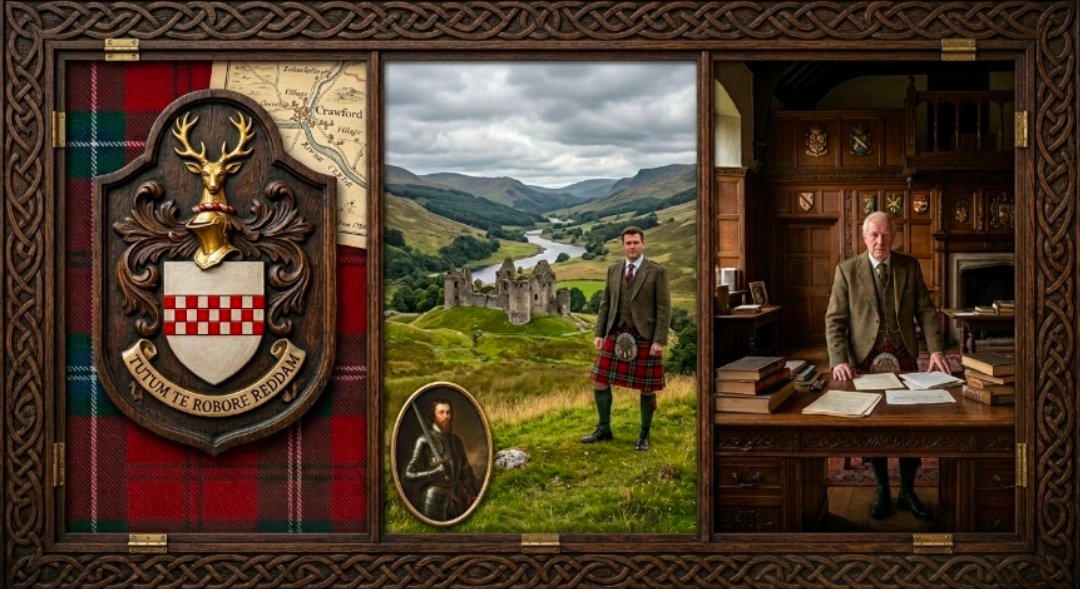
Some surnames announce their history — every Smith descends from a forge, every Baker from an oven. Crawford keeps its secrets better. It reads like it could be English, sounds solidly transatlantic, and yet it’s one of the oldest territorial surnames in Scotland, carried by a family whose story threads through eight centuries of border wars, royal service, and one connection to Scotland’s national hero that most Crawfords have never heard.
For the many thousands who carry the name across the world today, here’s the full excavation: where it comes from, who bore it, and what a modern Crawford inherits along with the spelling.
A name made of land
Crawford is a territorial surname — taken not from a trade or a father’s name but from a place. That place is the old barony of Crawford in Lanarkshire, in the upper valley of the River Clyde, where the village of Crawford still sits beside the ruins of its castle. When surnames crystallised in Scotland during the twelfth and thirteenth centuries, the family holding those lands became, simply, “of Crawford” — de Crawford in the charters — and the place-name became a bloodline.
The place-name itself is older than the family and has kept etymologists arguing. The second element is straightforward Old English: ford, a river crossing — fitting for a settlement commanding the upper Clyde. The first element is traditionally read as “crow” (Old English crawe), giving the pleasingly plain “ford of the crows,” though a competing derivation from a Brittonic root has its advocates. Either way, the picture is the same: a strategic crossing in the Southern Uplands, important enough that the family controlling it took its name and carried it into history. Anyone researching the Crawford name origin quickly discovers this dual character — a name at once humbly geographic and attached to serious medieval power.
The first Crawfords on record
The documentary trail begins remarkably early. Crawfords witness Scottish charters in the twelfth century — among the earliest, a Galfridus (Geoffrey) de Crawford appears in records around the 1170s, and the family multiplies through the thirteenth century into distinct branches. Two mattered most: the Crawfords of Auchinames in Renfrewshire, long recognised as the principal line, and the Crawfords of Craufurdland in Ayrshire, whose tower house near Kilmarnock — expanded over six centuries — stayed in family hands into modern times, one of Scotland’s longest continuous family residencies.
That south-western concentration — Lanarkshire origins, Renfrewshire and Ayrshire estates — placed the Crawfords at the centre of the network of families who would carry Scotland’s wars of independence.
The Wallace connection
Here is the detail that startles most Crawford researchers: by strong and long-standing tradition, the mother of William Wallace was Margaret Crawford, daughter of Sir Reginald Crawford, hereditary Sheriff of Ayr. If the tradition holds — and it has been repeated since the earliest accounts of Wallace’s life — then Scotland’s national hero was half Crawford, and his uncle’s household in Ayrshire part of the world that raised him.
The family paid for the association in blood. In 1297, English forces summoned Ayrshire’s gentry to the Barns of Ayr and hanged them from the rafters — Sir Reginald Crawford among the victims, in the atrocity that tradition says helped ignite Wallace’s campaign. Later Crawfords served under Wallace and Bruce through the wars that followed. It’s a reminder that the “supporting families” of Scottish history often stood closer to its centre than the famous names suggest.
Motto, crest, and the badge of a stag
Crawford heraldry carries the memory of service. The chiefly arms feature the ermine and gules of the old line, and the crest badge worn by clan members shows a stag’s head, with the motto Tutum te robore reddam — “I will make you safe by my strength.” It’s a bodyguard’s motto, and tradition attaches it to exactly that kind of act: a Crawford credited with saving a king’s life during a hunt, rewarded with lands and the emblem of the beast involved. As with most crest legends, the documentation is thinner than the story — but the motto is real, recorded, and one of the more distinctive in Scottish heraldry: not a boast about the bearer, but a promise to someone else.
For family researchers, the usual caution applies double with a name this old: the clan crest badge (stag and motto in the strap-and-buckle surround) may be worn by anyone of the name, while specific coats of arms belong to individual armigers and their direct heirs. Crawford arms exist in many recorded branch variations — a genealogist’s gift, since a documented armorial line can anchor a family tree with unusual precision.
Tartan and the modern clan
The Crawford tartan is a graceful red-ground sett crossed with green and white lines — recorded in the nineteenth-century collections and worn today across kilts, sashes, and accessories. An ancient-colourway version softens the red toward brick and moss for those who prefer the muted palette. The name is currently an armigerous clan — historically chief-bearing, presently without a recognised chief — but far from dormant: Clan Crawford societies operate internationally, gather at Highland games, and maintain active genealogical projects, including DNA studies mapping the branches that emigration scattered.
And scattered they were. Ulster plantation carried Crawfords into Ireland in numbers (the name remains common across the north of Ireland); from there and from Scotland directly, the name sailed to America, Canada, Australia, and New Zealand. Spelling drifted en route — Crawford, Craufurd, Crauford, Crawfurd — with the “Craufurd” form persisting in some of the oldest Scottish lines. Anyone hunting ancestors should search all four.
Standing where they stood
The heritage trail is compact and rewarding: the village of Crawford and its castle mound in the Clyde valley; Craufurdland Castle near Kilmarnock; the Ayrshire coast where the sheriff’s line held office; and Kilbirnie’s remarkable “Crawford aisle,” the seventeenth-century laird’s loft in the parish kirk, one of the most ornate pieces of family woodwork surviving in Scotland.
For wearing the connection rather than walking it, the practicalities are easy: the Crawford sett is woven to order by Highland-wear specialists — houses like Scottish Kilt Shop produce it across kilts, skirts, scarves, and full outfits — which means a family reunion or a wedding can put the whole line back in its colours for the first time in generations.
Researching your own Crawford line: a starter method
A name this old and this travelled rewards a systematic search. The working sequence genealogists use:
Fix the spelling last, not first. Search all four historic forms — Crawford, Craufurd, Crauford, Crawfurd — plus phonetic strays (Crofford, Craford) in every index. Record-keepers standardised nothing before the nineteenth century, and the oldest Scottish lines are precisely the ones most likely to hide under Craufurd.
Work the Ulster hinge. An enormous share of American and Canadian Crawfords route through the north of Ireland rather than directly from Scotland — plantation-era settlement made the name common across Antrim, Down, and Donegal by the 1700s. If your immigrant ancestor’s origin says “Ireland,” that’s not a dead end for the Scottish connection; it’s usually the middle chapter. Irish church registers and the surviving fragments of pre-1900 records, plus emigration-era ship manifests, bridge the gap more often than families expect.
Use the Scottish record spine. Scotland’s statutory registers, old parish records, and testament indexes are unusually centralised and searchable; a Crawford line that reaches Scotland before 1855 can often be walked back parish by parish through Ayrshire, Renfrewshire, and Lanarkshire — the three counties where the odds concentrate.
Let DNA arbitrate. The clan’s active surname DNA projects have already mapped several distinct Crawford lineages and connected scattered branches to them; for male-line Crawfords, a Y-DNA test plus project membership frequently resolves in months what paper alone couldn’t in years — including which of the historic branches (Auchinames, Craufurdland, and their cadets) a family plausibly descends from.
Then anchor it in place. Once the paper trail lands in a parish, the heritage trail above stops being tourism and becomes biography — a specific kirk, a specific glen, occasionally a specific pew. That’s the moment most researchers describe as the point of the whole exercise.
What the name carries
Strip away the charters and the heraldry and the Crawford inheritance comes down to three things: a place — a river crossing you can still stand at; a promise — that singular bodyguard’s motto about making others safe; and a proximity to history — the family that guarded sheriffs, raised (perhaps) a hero’s mother, and paid at the Barns of Ayr. Not bad for a name that sounds, at first hearing, like it could belong to anyone. It belonged to somewhere first — and eight hundred years later, the somewhere is still on the map. Stand at the Crawford crossing with the Clyde running past, and the whole surname compresses into a single view: the ford, the family that guarded it, and the name that carried both to every continent. Genealogy rarely offers a destination that literal — Crawfords should take the trip.