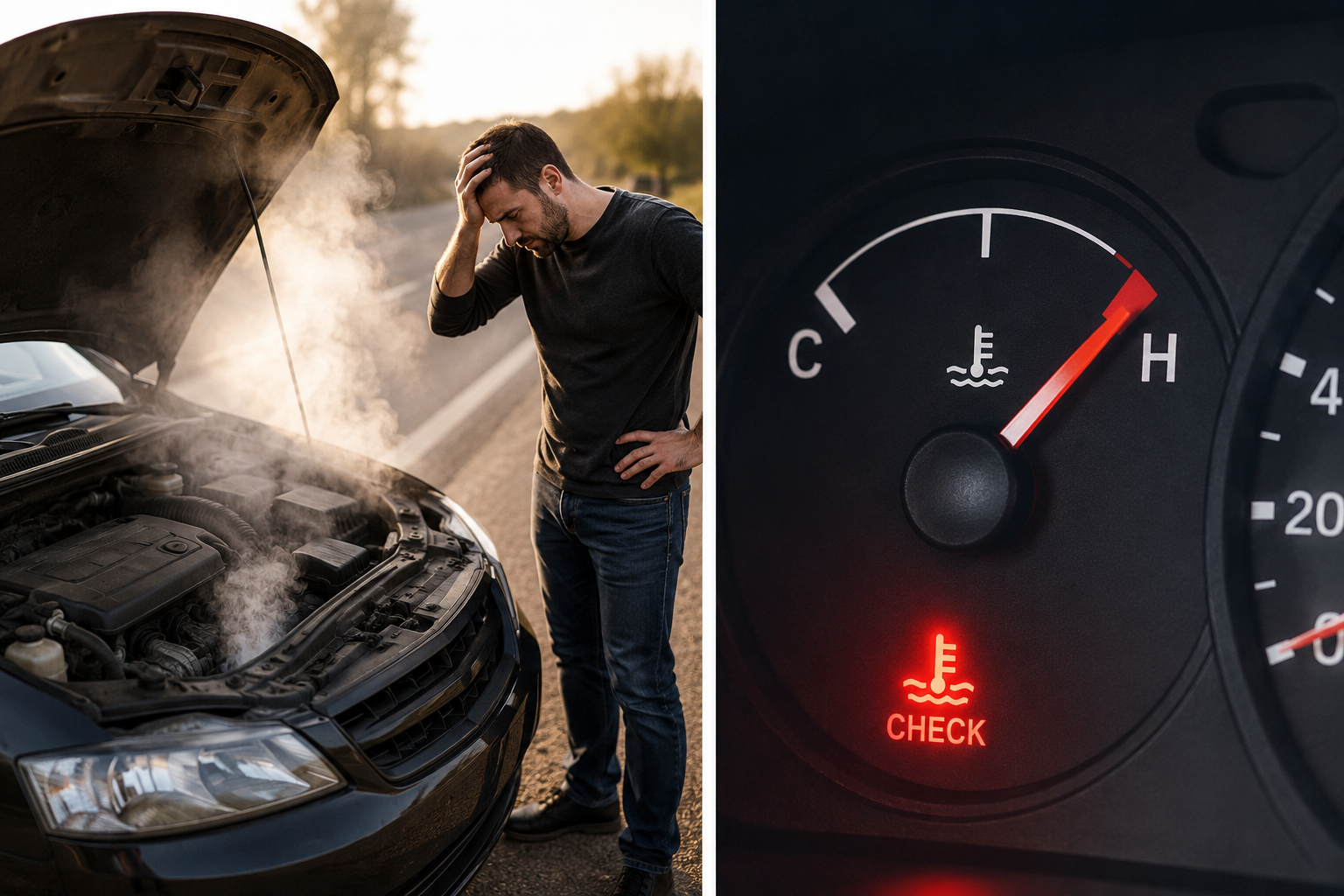
Watching your temperature gauge creep towards the red on the A30 near Fleet is never a pleasant experience, especially when you are miles from home with no hard shoulder. An overheating engine is one of those problems that can escalate quickly if ignored, turning a minor coolant top-up into a warped cylinder head or blown head gasket before you reach your destination. Understanding what causes it, and how to spot the early signs, can save you a lot of stress, expense, and an inconvenient call to your breakdown provider.
At our garage in Church Crookham, we see cooling system faults almost daily, particularly during the warmer months when Hampshire traffic and summer heat place extra demand on already tired components. This guide runs through the most common reasons cars overheat, what each one looks and feels like from behind the wheel, and what steps to take if it happens to you.
How Your Cooling System Works, A Quick Overview
Before looking at the causes, it helps to understand the basics. Your engine generates a huge amount of heat as it runs, and the cooling system exists to manage that heat and keep everything operating within a safe range.
Coolant circulates through the engine, absorbing heat, before passing through the radiator where it is cooled by air flow. A thermostat regulates when coolant flows, a water pump keeps it moving, and various hoses and seals keep the whole system contained. If any single part of this chain fails, the engine can quickly start running hotter than it should.
The 10 Most Common Causes of Overheating
1. Low Coolant Levels
This is by far the most common cause of overheating. Coolant naturally evaporates over time, and small leaks can gradually reduce the level without being obvious. Without enough coolant circulating, the engine loses its main defence against excess heat.
Checking your coolant level regularly, particularly before long journeys, is one of the simplest habits that can prevent this entirely.
2. Coolant Leaks
Leaks can develop in hoses, the radiator itself, the water pump, or various seals and gaskets. A sweet smell inside or outside the car, or small puddles under the vehicle, are common signs. Even a small leak can cause a gradual drop in coolant level that eventually leads to overheating if not addressed.
3. Faulty Thermostat
The thermostat controls when coolant flows to the radiator. If it becomes stuck closed, coolant cannot circulate properly, and the engine temperature can rise quickly, sometimes within minutes of starting a journey. This is a relatively common fault and, fortunately, a straightforward one to diagnose and replace.
4. Failing Water Pump
The water pump keeps coolant moving through the engine and radiator. If it fails, whether due to a worn bearing, a broken belt, or internal wear, circulation stops almost entirely. A whining noise from the front of the engine, or visible coolant leaking near the pump, can be early warning signs before a complete failure occurs.
5. Radiator Problems
A blocked, damaged or clogged radiator cannot dissipate heat effectively, even if coolant levels are fine. Debris, insects and road grime can build up on the radiator fins over time, particularly if the car is driven frequently on rural roads. Internal blockages, often caused by old or contaminated coolant, can also restrict flow.
6. Broken or Slipping Drive Belt
Many cooling systems rely on a belt to drive the water pump or cooling fan. If this belt becomes worn, loose or breaks entirely, the pump may stop working effectively, cutting off coolant circulation. A squealing noise from the engine bay is often an early clue that a belt is wearing out.
7. Faulty Cooling Fan
The cooling fan helps draw air through the radiator, particularly at low speeds or when the car is stationary with the engine running. If the fan motor fails, or the fan does not engage when it should, the engine can overheat in slow traffic or during idling, even though it may run fine at higher speeds on the motorway.
8. Blocked Heater Core
The heater core is part of the cooling system that also supplies warm air to the cabin. If it becomes blocked, it can disrupt coolant flow through the wider system. Interestingly, a sudden lack of warm air from the vents can sometimes be an early clue that something is wrong before the temperature gauge itself shows a problem.
9. Old or Contaminated Coolant
Coolant does not last forever. Over time, it loses its ability to resist corrosion and can become contaminated with rust or scale, which reduces its efficiency and can clog narrow passages within the system. This is one of the reasons coolant is checked and, where necessary, replaced as part of a full service.
10. Driving Conditions and Heavy Load
Stop start traffic, towing, or driving in very hot weather all place extra demand on the cooling system. A system that is already slightly under strain, perhaps with marginally low coolant or a partially blocked radiator, is far more likely to tip into overheating under these conditions. This is particularly common in the warmer summer months.
Warning Signs You Should Never Ignore
Certain symptoms indicate you should stop driving as soon as it is safe to do so, rather than continuing to your destination.
- The temperature gauge reading in or near the red zone.
- Steam or smoke coming from under the bonnet.
- A strong sweet smell, which usually indicates a coolant leak.
- Warning lights on the dashboard specifically related to engine temperature.
- A sudden loss of power or the engine running unusually rough.
Continuing to drive an overheating car can cause serious and expensive engine damage, including warped cylinder heads or a blown head gasket, so it is always safer to stop and assess the situation.
What to Do If Your Car Starts Overheating
If you notice the temperature gauge rising while driving, pull over safely as soon as possible and switch off the engine. Do not attempt to open the radiator cap while the engine is hot, as pressurised coolant can cause serious burns. Allow the car to cool for at least twenty minutes before checking coolant levels, and avoid adding cold water or coolant to a hot engine.
If the level is visibly low and you have coolant available, topping up once the engine has cooled may allow you to continue cautiously to your nearest garage. If the cause is unclear, or the car overheats again shortly after, it is best to arrange recovery rather than risk further damage.
Preventing Overheating Before It Starts
Most overheating problems develop gradually, which means there is usually a window of opportunity to catch them early. Checking coolant levels monthly, and before any long journey, takes only a few minutes. Keeping an eye out for sweet smells, dashboard warnings or gradual changes in temperature gauge behaviour can also flag a developing issue before it becomes serious.
Routine car servicing typically includes a check of coolant levels, hoses, belts and the overall condition of the cooling system, making it one of the most effective ways to catch a fault before it leaves you stranded. Ahead of warmer months, our guide on preparing your car for summer covers a few extra checks worth running through, since cooling systems tend to work hardest during hot weather.
Why Overheating Is Also Checked During an MOT
While an MOT does not test the cooling system as thoroughly as a full service, visible issues such as leaking coolant, a damaged radiator or a badly deteriorated hose can sometimes be flagged during your annual MOT test. Catching this kind of fault at MOT time, rather than on the side of the road, is one of the small advantages of keeping up with your annual test even if your car feels like it is running fine.
How This Differs From Other Engine Temperature Issues
It is worth briefly distinguishing overheating from a car simply running slightly warmer than usual, which is not always a fault. Modern engines run at a higher baseline temperature than older vehicles by design, and a needle sitting in the upper normal range on a hot day is not automatically cause for concern. Genuine overheating is characterised by the needle moving into the red zone, warning lights activating, or physical signs like steam and smell. If you are ever unsure whether a reading is normal for your specific vehicle, checking your handbook or having it looked at during a routine check is a simple way to put your mind at ease rather than guessing.
Common Overheating Myths That Can Make Things Worse
A few widely repeated pieces of advice around overheating are either outdated or simply incorrect, and following them can sometimes make the problem worse rather than better.
Myth, turning the heater on full blast fixes overheating. There is a small grain of truth here, running the heater can draw a little heat away from the engine in an emergency, but it is a short term stopgap at best, not a fix. It buys you a few extra minutes, nothing more, and should never replace pulling over and switching off.
Myth, adding cold water to a hot radiator is safe. Pouring cold liquid into a hot engine can cause the metal to contract rapidly and, in some cases, crack the engine block or cylinder head. Always wait until the engine has cooled before adding anything.
Myth, if the gauge drops back to normal, the problem has resolved itself. Sometimes a temporary airlock or a brief blockage clears on its own and the gauge settles, but this does not mean the underlying cause, whether a slow leak or a failing part, has gone away. It usually means the same issue will return, often at a less convenient moment.
Myth, overheating is only a summer problem. While hot weather does increase the load on your cooling system, faults like a stuck thermostat, a failing water pump or a coolant leak can cause overheating at any time of year. Cold weather can be just as unforgiving if coolant is old or diluted incorrectly, since it also affects the antifreeze properties that protect the engine.
Knowing which of these are genuine advice and which are simply myths can prevent a bad situation from turning into a much more expensive one.
Overheating Causes at a Glance
The table below summarises the ten causes covered in this guide, along with the key warning sign to watch for and how urgently each one typically needs attention.
| Cause | Key Warning Sign | Urgency |
| Low coolant levels | Gradual rise in temperature gauge | Check soon |
| Coolant leaks | Sweet smell, puddles under car | Check soon |
| Faulty thermostat | Rapid temperature rise after starting | Prompt attention |
| Failing water pump | Whining noise, visible leak near pump | Prompt attention |
| Radiator problems | Poor cooling despite full coolant | Check soon |
| Broken or slipping drive belt | Squealing from engine bay | Prompt attention |
| Faulty cooling fan | Overheating in traffic, fine at speed | Prompt attention |
| Blocked heater core | Reduced warm air from vents | Check soon |
| Old or contaminated coolant | Gradual efficiency loss, discoloured coolant | Routine check |
| Heavy load or hot weather | Overheating under strain, normal otherwise | Monitor |
This table is a general guide rather than a diagnosis. If more than one of these signs appears at once, it is worth having the cooling system looked at properly rather than trying to isolate the cause yourself.
Conclusion
An overheating engine is rarely caused by one dramatic failure, it is usually the result of a small, gradual issue that builds over time, whether that is a slow coolant leak, an ageing thermostat, a tired water pump or a radiator that has quietly become less effective. What makes overheating particularly worth taking seriously is how quickly a manageable fault can turn into a genuinely expensive one, a warped cylinder head or blown head gasket can transform a simple coolant top up into a major engine rebuild, all within the space of a single journey if warning signs are ignored.
The encouraging part is that most causes covered in this guide give some form of early warning, whether that is a faint sweet smell, a slowly dropping coolant level, a squeal from the engine bay, or the heater blowing cooler air than expected. Paying attention to these small signals, rather than waiting for the temperature gauge to hit the red, is what separates a five minute check from a roadside breakdown. Building simple habits, checking coolant monthly, listening for new noises, and keeping up with routine servicing, goes a long way toward keeping your cooling system reliable throughout the year, not just during the warmer months when the strain is most obvious.
TJ Services is a DVSA-approved MOT and service centre based in Fleet, Hampshire. Our technicians diagnose cooling faults, carry out full services, and perform MOTs for drivers across Church Crookham, Farnborough, Hook, Hartley Wintney and Yateley. See what our customers say on Google, or call us on 01252 622200 to book a cooling system check.
Frequently Asked Questions
Can I keep driving if my car is slightly overheating?
It is best to stop as soon as safely possible. Continuing to drive, even briefly, risks serious and costly engine damage.
How often should I check my coolant level?
Checking monthly, and always before a long journey, is a good habit, particularly during summer when the cooling system works harder.
Why does my car only overheat in traffic?
This often points to a faulty cooling fan, which is needed most at low speeds when there is less natural airflow through the radiator.
Is it normal for coolant to need topping up regularly?
No, coolant levels should stay fairly stable. Frequent topping up usually indicates a leak somewhere in the system that needs investigating.
Does overheating always mean expensive engine damage?
Not necessarily, especially if caught early. Simple causes like low coolant or a faulty thermostat are usually straightforward and affordable to fix if addressed promptly.