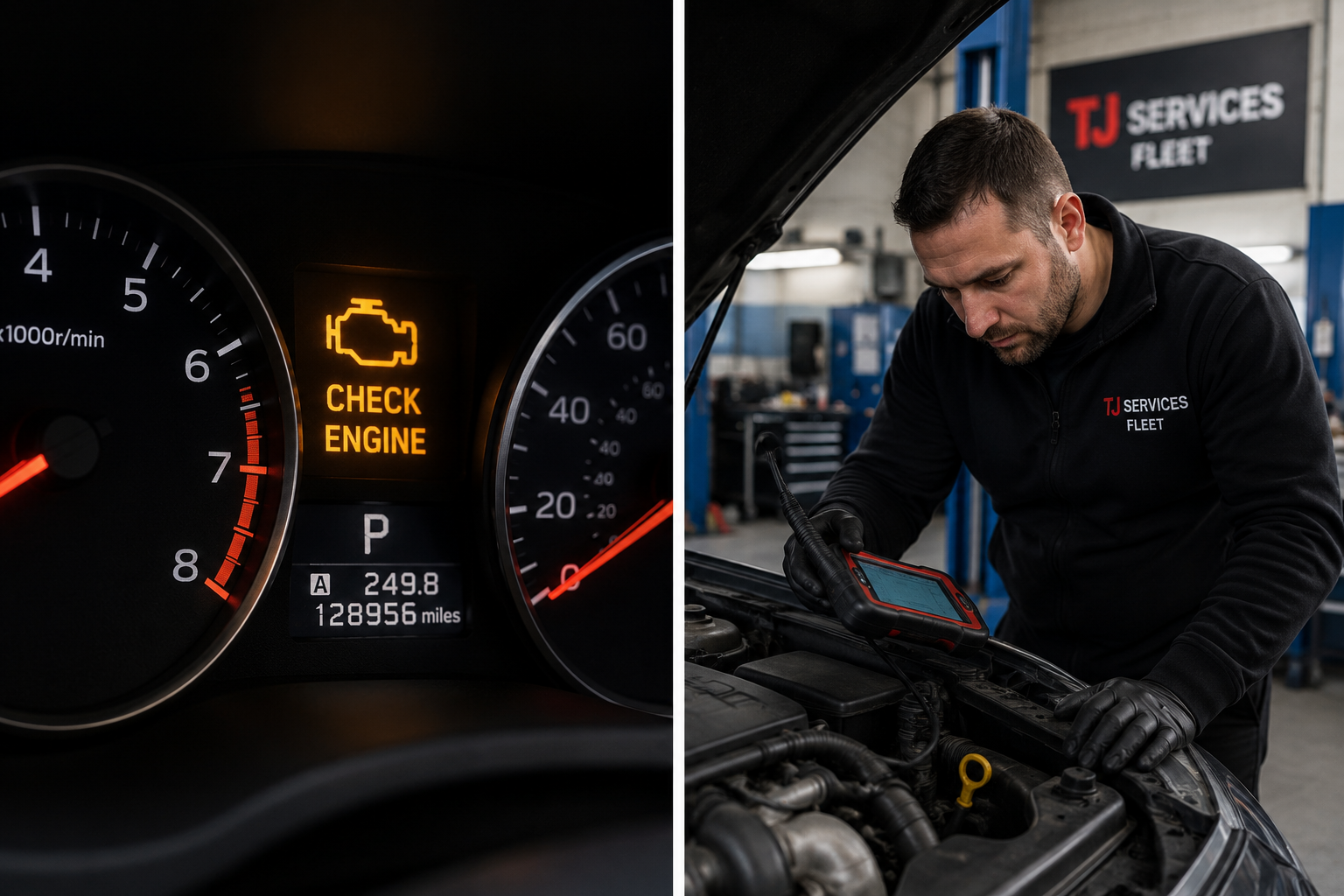
Seeing the check engine light appear on your dashboard can be worrying, but it doesn’t always mean there’s a serious problem. In many cases, the warning is triggered by a relatively minor issue, while in others it signals a fault that needs immediate attention to prevent costly engine damage. Understanding what the light means, and how urgently you should respond, can help you avoid unnecessary stress and expensive repairs.
Also known as the engine management light (EML), the check engine light is connected to your vehicle’s onboard diagnostic system. When the engine control unit (ECU) detects something operating outside its normal range, it stores a fault code and switches the warning light on. The cause could be something as simple as a loose fuel cap or something more serious such as a failing catalytic converter, ignition fault or blocked diesel particulate filter.
This guide explains 15 of the most common reasons the check engine light comes on, how to tell whether it’s safe to keep driving and what steps you should take before the problem becomes more expensive to fix.
Solid or Flashing: The Distinction That Matters Most
Before getting into the causes, there is one thing every driver needs to understand about the check engine light, and it is the difference between a steady light and a flashing one.
A steady amber check engine light means a fault has been detected and needs attention, but there is no immediate emergency. You can generally continue driving with care and book engine diagnostics in Aldershot as soon as possible.. The underlying issue will not always worsen rapidly, but ignoring it for weeks is not advisable.
A flashing or blinking check engine light is a different matter entirely. A flashing light almost always indicates an active engine misfire, meaning unburned fuel is entering the exhaust system. Every mile you drive in this state risks damaging the catalytic converter, which is a far more expensive repair than whatever caused the misfire in the first place. If your light is flashing, reduce speed, avoid hard acceleration, and get the car to a garage promptly. If the car is also shaking, misfiring noticeably, or the light turns red, stop driving and arrange collection.
It is also worth knowing that an illuminated check engine light is an automatic MOT failure for most vehicles registered after July 2003 for petrol and July 2008 for diesel. If your MOT is approaching and the light is on, addressing it beforehand is essential.
15 Common Causes of the Check Engine Light
1. A Loose or Faulty Fuel Cap
Start here before anything else. The fuel cap is part of a sealed evaporative emissions system that prevents fuel vapour from escaping into the atmosphere. If the cap is not properly tightened after refuelling, or if the rubber seal has deteriorated, the system detects a pressure leak and triggers the check engine light.
This is one of the most common causes and one of the cheapest to resolve. Remove the fuel cap, inspect the rubber seal for cracks or damage, refit it securely, and in many cases the light will clear itself after a few drive cycles. If it does not, the EVAP system itself may need investigating.
2. A Faulty Oxygen Sensor
The oxygen sensor, also known as the lambda sensor, monitors how much unburned oxygen is present in the exhaust gases. This data helps the ECU calculate the correct fuel and air mixture for efficient combustion. A failing sensor sends inaccurate readings, causing the engine to run either too rich or too lean, which reduces fuel economy, increases emissions, and in time can damage the catalytic converter.
Oxygen sensor failure is one of the most frequent causes of the check engine light in UK cars. Most vehicles have multiple sensors, and they do wear out over time, particularly on higher-mileage vehicles. Replacement is relatively straightforward and far less expensive than the secondary damage caused by leaving a faulty sensor in place.
3. A Failing Catalytic Converter
The catalytic converter sits in the exhaust system and converts harmful gases produced by combustion into less harmful substances before they exit the tailpipe. When it degrades or becomes blocked, the car produces higher emissions, fuel economy drops, and performance can suffer noticeably.
Catalytic converter failure often develops as a consequence of other unresolved faults, particularly oxygen sensor problems or engine misfires that allow unburned fuel to enter and overheat the converter. This is why addressing earlier warning signs promptly genuinely saves money. A failed catalytic converter is among the more expensive check engine light repairs.
4. Worn or Fouled Spark Plugs
Spark plugs ignite the air and fuel mixture in each cylinder. When they wear out, become fouled with carbon deposits, or fail entirely, the engine misfires. A misfire means one or more cylinders are not firing correctly, which causes rough running, poor acceleration, reduced power, and in many cases a flashing check engine light.
Spark plugs have a defined service life and should be replaced at the intervals specified in your vehicle’s handbook. Ignoring worn plugs puts unnecessary stress on the ignition coils and risks allowing the misfire to damage the catalytic converter.
5. A Faulty Ignition Coil
The ignition coil converts the low voltage from the battery into the high voltage needed to create the spark that fires each cylinder. Most modern cars use individual coil-on-plug units, one per cylinder, which means a single coil can fail while the others remain fine.
A failed ignition coil typically produces a cylinder misfire, rough idling, hesitation on acceleration, and often a flashing check engine light. Coil failures are relatively common on higher-mileage vehicles, and since all coils age at a similar rate, it is often worth replacing them as a set rather than addressing one at a time.
6. A Blocked or Failing Diesel Particulate Filter
For diesel drivers, a blocked DPF is one of the most frequently encountered check engine light causes. The diesel particulate filter traps soot particles from the exhaust and periodically burns them off in a process called regeneration. This regeneration requires the engine to reach a sustained operating temperature, which typically happens during longer journeys at consistent speeds.
Drivers who predominantly make short trips around town, through Fleet, Farnham, or the roads around Ash Road, never give the DPF the sustained heat it needs to complete a regeneration cycle. Over time, soot accumulates until the filter becomes blocked, triggering the check engine light and often putting the car into a reduced power mode. In some cases, a longer motorway drive can assist regeneration. In others, a forced regeneration by a technician or a DPF clean is required.
7. A Dirty or Failing Mass Airflow Sensor
The mass airflow sensor, or MAF sensor, measures the volume of air entering the engine so the ECU can calculate how much fuel to inject. A dirty or failing sensor sends incorrect data, disrupting the fuel and air balance. The result is poor fuel economy, hesitation on acceleration, rough idling, and a triggered check engine light.
MAF sensors can often be restored by cleaning with specialist sensor cleaner spray, which is a straightforward job. If the sensor itself has failed, replacement is necessary. Either way, this is a relatively common fault that a diagnostic scan will identify quickly.
8. A Clogged or Faulty EGR Valve
The exhaust gas recirculation valve returns a portion of exhaust gases back into the engine’s intake to reduce combustion temperatures and lower emissions. On diesel vehicles particularly, the EGR valve is highly susceptible to carbon deposit build-up, especially in cars used mainly for short urban journeys.
A clogged or stuck EGR valve causes rough idling, increased emissions, reduced power, and frequently sends the car into limp mode, a reduced power state designed to protect the engine. It is a common fault on diesel vehicles across the UK and one that tends to worsen gradually rather than appearing suddenly.
9. A Failing Throttle Position Sensor
The throttle position sensor tells the ECU how far the accelerator pedal is being pressed, allowing the engine to respond appropriately. A failing sensor produces erratic throttle response, poor fuel economy, hesitation on acceleration, and in some cases stalling at low speeds.
Drivers often describe the sensation as the car surging or feeling unpredictable at low speeds, which can be unsettling in stop-start traffic. A diagnostic scan will identify a throttle position sensor fault quickly, and replacement is generally straightforward.
10. A Vacuum Leak
Modern engines rely on a network of rubber hoses and plastic connectors to manage air intake, brake boost, and emissions control. These hoses degrade over time, particularly as cars age and are exposed to heat cycling. A split, cracked, or disconnected vacuum hose allows unmetered air into the intake system, upsetting the fuel and air balance and triggering the check engine light.
Vacuum leaks can produce a hissing sound from the engine bay, rough idling, or hesitation on acceleration. They are particularly common on older vehicles and are often found during a thorough visual inspection of the engine bay.
11. Problems with Fuel Injectors
Fuel injectors deliver precise quantities of fuel directly into the engine’s cylinders. Over time, they can become partially blocked with deposits or develop electrical faults, causing them to deliver too much or too little fuel. The result is poor performance, rough running, higher fuel consumption, and a check engine light.
Injector issues are more common on higher-mileage diesel vehicles but can affect petrol engines too. Injector cleaning treatments added to the fuel can address mild deposit build-up. More significant faults will require the injectors to be cleaned professionally or replaced.
12. A Faulty Coolant Temperature Sensor
The coolant temperature sensor monitors the engine’s operating temperature and feeds this data to the ECU. If the sensor sends incorrect readings, the ECU may deliver the wrong fuel mixture, cause the engine to run inefficiently, and trigger the check engine light. In some cases, a faulty sensor can cause the engine to run as if it is perpetually cold, leading to higher fuel consumption and increased wear.
This fault rarely produces dramatic symptoms beyond the warning light and slightly altered engine behaviour, which is why many drivers dismiss it until a diagnostic scan identifies it.
13. An Issue with the Evaporative Emission Control System
The EVAP system captures fuel vapour from the fuel tank and prevents it from escaping into the atmosphere. Any leak in this system, whether from a faulty purge valve, a cracked hose, or a degraded fuel cap seal, triggers a fault code and illuminates the check engine light. EVAP faults are rarely urgent but will cause an MOT emissions failure if left unresolved.
14. A Battery or Charging System Fault
A weak or failing battery, a faulty alternator, or a poor electrical connection can all produce check engine light codes. The ECU relies on a stable electrical supply to function correctly, and voltage irregularities can cause it to log false fault codes across multiple systems, sometimes creating a confusing cluster of warning lights.
If the check engine light appeared shortly after a battery replacement or jump start, a charging system fault is worth investigating first before assuming an engine or emissions problem.
If you’re unsure what has triggered the warning light, the experienced team at Ash Road Service Centre can carry out a professional diagnostic inspection and explain exactly what the fault codes mean.
15. A Faulty Camshaft or Crankshaft Position Sensor
These sensors tell the ECU the precise position of the engine’s rotating components, which is critical for accurate ignition timing and fuel injection. A failing camshaft or crankshaft position sensor can cause the engine to misfire, hesitate, stall unpredictably, or in more serious cases refuse to start at all. The check engine light will illuminate, and a diagnostic scan will point directly to the affected sensor.
What to Do When the Check Engine Light Comes On
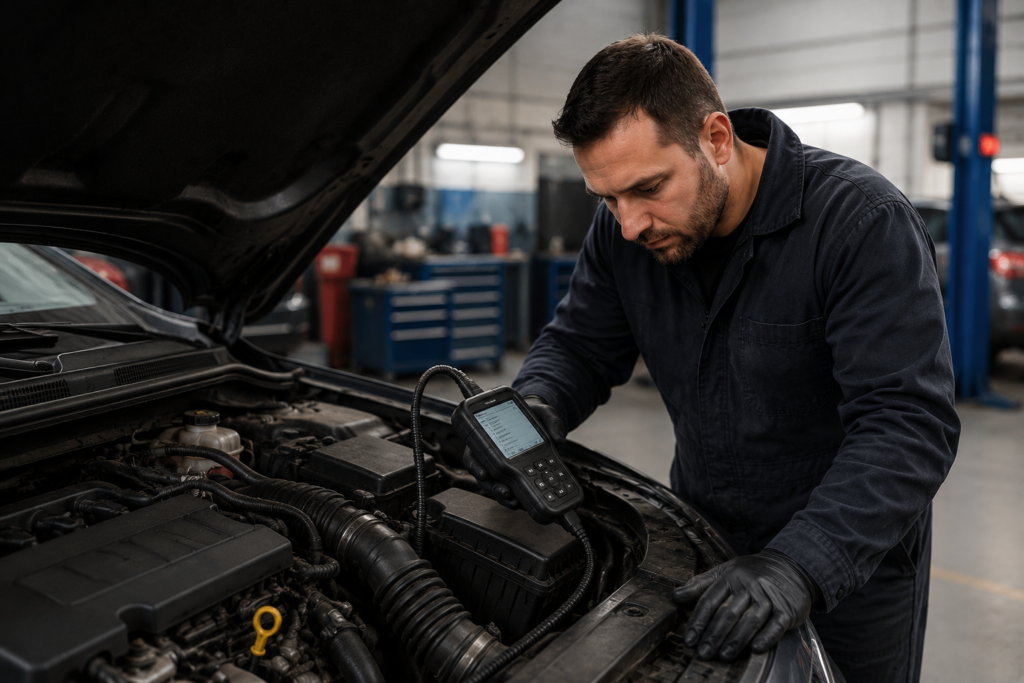
Here is a straightforward sequence to follow the moment the light appears.
- Note whether the light is steady or flashing. A flashing light means reduce speed immediately and get the car inspected urgently. A steady light means book a diagnostic check as soon as possible.
- Check the fuel cap. Remove it, inspect the seal, refit it firmly, and give the car a few drive cycles to see if the light clears. This costs nothing and rules out one of the most common causes straight away.
- Look for any accompanying symptoms. Rough idling, loss of power, unusual smells, poor fuel economy, or hesitation on acceleration all give a technician additional context when diagnosing the fault.
- Do not clear the code without fixing the fault. Some drivers use a basic OBD reader to reset the light and hope for the best. The code will return, and in the meantime you are driving without knowing what your car is trying to tell you.
- Book a proper diagnostic check. A qualified technician with the right equipment will retrieve the stored fault codes and identify the exact cause.
- If your MOT is due soon, get the light investigated before the test. An illuminated check engine light is an automatic MOT failure for most modern vehicles. Addressing it beforehand saves the cost of a failed test and a retest fee.
A Quick Reference: 15 Causes at a Glance
| Cause | Urgency | Likely Symptom |
| Loose fuel cap | Low | Light only, no performance change |
| Faulty oxygen sensor | Medium | Poor fuel economy, higher emissions |
| Failing catalytic converter | Medium to high | Reduced performance, sulphur smell |
| Worn spark plugs | Medium | Rough idle, misfiring, hesitation |
| Faulty ignition coil | Medium to high | Misfire, rough running, flashing light |
| Blocked DPF | High | Reduced power, limp mode |
| Dirty MAF sensor | Medium | Hesitation, poor fuel economy |
| Clogged EGR valve | Medium to high | Rough idle, reduced power |
| Throttle position sensor | Medium | Erratic throttle, hesitation |
| Vacuum leak | Medium | Rough idle, hissing sound |
| Fuel injector fault | Medium | Poor performance, rough running |
| Coolant temperature sensor | Low to medium | Altered fuelling, light only |
| EVAP system fault | Low | Light only, possible fuel smell |
| Battery or charging fault | Medium | Multiple warning lights |
| Camshaft or crankshaft sensor | High | Stalling, misfire, starting issues |
Does the Check Engine Light Mean MOT Failure?
Yes, in most cases. For petrol vehicles registered after July 2003 and diesel vehicles registered after July 2008, an illuminated check engine light is classified as a major defect during an MOT and results in an automatic failure. The tester checks that the light illuminates during the ignition self-check and then extinguishes once the engine starts. If it remains on, the car fails. If the light does not illuminate at all, that is also a failure.
This is one of the most important reasons not to ignore the check engine light or simply reset it without addressing the fault. A stored code that keeps the light on will cause a failed MOT regardless of how well the car appears to be running.
Conclusion
The check engine light is not the enemy. It is your car communicating with you through the most direct channel available: a warning symbol you cannot miss. The 15 causes covered in this guide range from a loose fuel cap that takes thirty seconds to address to a blocked DPF that needs professional intervention. In almost every case, the outcome is better when the fault is investigated promptly rather than ignored.
A diagnostic scan is the only way to know for certain what is triggering the light. It takes a matter of minutes, removes all the guesswork, and gives you a clear picture of what needs to be done and how urgently. The longer the light is left on, the greater the risk that a minor fault develops into something more significant and more expensive. Act on it early, and the check engine light becomes exactly what it was designed to be: useful information delivered in time to make a difference.
If the warning light stays on after restarting the vehicle, you can find Ash Road Service Centre on Google to read customer reviews or arrange a diagnostic inspection.
Frequently Asked Questions
Is it safe to drive with the check engine light on?
In most cases, yes, provided the light is steady rather than flashing and the car is running normally. A steady amber light indicates a fault that needs attention but does not typically pose an immediate danger. A flashing light is more urgent and means you should reduce speed and get the car inspected as soon as possible.
What is the most common cause of the check engine light?
A loose or faulty fuel cap is one of the most frequent triggers, particularly in the hours after refuelling. Beyond that, faulty oxygen sensors, worn spark plugs, and blocked DPFs are among the most commonly diagnosed causes in UK vehicles.
Will the check engine light go off by itself?
Sometimes. If the cause was a temporary fault, such as a momentarily loose fuel cap, the light may clear after a few drive cycles once the ECU has confirmed the issue is no longer present. However, if an underlying fault persists, the light will stay on or return. It is always worth investigating rather than waiting for the light to disappear on its own.
Can I reset the check engine light myself?
A basic OBD2 reader can clear stored fault codes and turn the light off. However, if the underlying problem has not been fixed, the light will return. Clearing the code without resolving the fault gives a false sense of reassurance and does nothing to protect the engine or pass an MOT.
How long can I leave the check engine light on?
You should not leave it long. While the car may continue to run apparently normally, an unresolved fault can worsen over time and create secondary damage. A faulty oxygen sensor left unaddressed, for example, can eventually damage the catalytic converter, turning a moderate repair into a significantly more expensive one.
Does the check engine light always mean an MOT failure?
For most modern vehicles, yes. An illuminated check engine light is a major defect under current MOT inspection guidelines and results in an automatic failure. The only exceptions are older vehicles registered before the relevant dates for petrol and diesel engines respectively. For the majority of drivers on UK roads today, the light must be off before the car can pass its test.